
About
From Basra airfield to the boardroom.
Twenty-seven years as a Royal Air Force Communications Electronics Officer, then nearly two decades as an independent Project Director. The thread running through both is the same: complex delivery, difficult stakeholders, and a deadline that was never going to move.
1980 — 2007
Twenty-seven years in the Royal Air Force.
I joined the Royal Air Force in 1980 and left twenty-seven years later as a Communications Electronics Officer. In between I ran the RAF’s satellite training school, advised commanders, taught leadership at Staff College, and delivered communications programmes in places where the infrastructure either did not exist yet or had recently stopped existing.
The posting that shaped how I work was Basra, in the spring of 2003. As Project Director for the regeneration of Basra International Airport I led a fifty-strong multinational team to plan and install the airport’s communications and networks from nothing. The airfield reached the highest standard achieved for a deployed airfield, and international civilian flights resumed. There was no budget line for delay, and no version of the plan in which it simply did not happen.
Other postings built the commercial habits. In the Falkland Islands I advised the CEO and executive board on every aspect of global military communications and IT, delivered a £10M infrastructure upgrade, and introduced practices that saved £900,000 a year. At Brize Norton I led 145 staff across five locations and developed a fleet of rapidly deployable communications vehicles with EADS, taking £500,000 out of the equipment programme. At the MoD I held governance for a £3M research programme with DSTL and QinetiQ, and delivered an £8M media centre to time and budget.
Two years at Staff College in Shrivenham — mentoring officers through leadership and management training, and rebuilding four of the training packages — taught me most of what I know about getting people to commit to a plan rather than merely agree to it.
The posting that shaped how I work was Basra, in the spring of 2003. As Project Director for the regeneration of Basra International Airport I led a fifty-strong multinational team to plan and install the airport’s communications and networks from nothing. The airfield reached the highest standard achieved for a deployed airfield, and international civilian flights resumed. There was no budget line for delay, and no version of the plan in which it simply did not happen.
Other postings built the commercial habits. In the Falkland Islands I advised the CEO and executive board on every aspect of global military communications and IT, delivered a £10M infrastructure upgrade, and introduced practices that saved £900,000 a year. At Brize Norton I led 145 staff across five locations and developed a fleet of rapidly deployable communications vehicles with EADS, taking £500,000 out of the equipment programme. At the MoD I held governance for a £3M research programme with DSTL and QinetiQ, and delivered an £8M media centre to time and budget.
Two years at Staff College in Shrivenham — mentoring officers through leadership and management training, and rebuilding four of the training packages — taught me most of what I know about getting people to commit to a plan rather than merely agree to it.
Basra International Airport
March – July 2003 · Iraq
- Project Director for the airfield regeneration
- 50-strong multinational team
- Airport communications, WAN and LAN installed from scratch
- Highest standard achieved for a deployed airfield
- International civilian flights resumed
2007 — today
The journey since.
I left the RAF in 2007 and spent the first years building something of my own — Talk on the Tube, a social network for London — and then ran Smart Ad Solutions, a digital marketing consultancy. Both taught me the commercial end of delivery: how clients actually buy, how quickly a plan meets a budget, and how differently a private-sector board reads a risk register.
In 2012 I went back to large-scale programme delivery, and have contracted through Quantum Consulting Europe ever since. The first engagement was also the largest: a £54M network optimisation programme for EE covering 27,500 sites, mandated to realise £15M a year in synergy savings after the merger. It delivered benefits 53% above target in the first year.
What followed set the pattern for the work I do now. Colt International needed a relocation out of a fifty-year-old site delivered in 120 days after the original project manager walked, against real internal resistance to moving at all. Arqiva needed a £5M programme restarted when it was on the verge of failure; it was handed over £100,000 under budget, and they brought me back for three more years. Ashfield needed a six-month telephony programme inside a regulated healthcare business, and got it in four.
In between there have been deployments that looked rather more like the RAF years than the boardroom — running the programme office for FCO-sponsored justice and security projects in Somaliland, and standing up the in-country PMO for a Home Office-backed policing mission in the Middle East, including getting fifty-five instructors home safely when Covid ended the mission overnight.
In 2012 I went back to large-scale programme delivery, and have contracted through Quantum Consulting Europe ever since. The first engagement was also the largest: a £54M network optimisation programme for EE covering 27,500 sites, mandated to realise £15M a year in synergy savings after the merger. It delivered benefits 53% above target in the first year.
What followed set the pattern for the work I do now. Colt International needed a relocation out of a fifty-year-old site delivered in 120 days after the original project manager walked, against real internal resistance to moving at all. Arqiva needed a £5M programme restarted when it was on the verge of failure; it was handed over £100,000 under budget, and they brought me back for three more years. Ashfield needed a six-month telephony programme inside a regulated healthcare business, and got it in four.
In between there have been deployments that looked rather more like the RAF years than the boardroom — running the programme office for FCO-sponsored justice and security projects in Somaliland, and standing up the in-country PMO for a Home Office-backed policing mission in the Middle East, including getting fifty-five instructors home safely when Covid ended the mission overnight.
The record so far
- More than 25 projects delivered
- Budgets from £200,000 to £54M
- Teams from 5 to 150 people
- Waterfall, agile, and the honest compromises between them
- Public and commercial sector, UK and overseas
How I work
The work is nearly always the same shape.
Something has gone wrong, or is about to. Someone needs an honest read on why — not a reassuring one. Then someone has to build a plan people will genuinely back, and stay long enough to drive it through.
I am at my most useful in that third part. A technically sound plan the board does not believe in is not a plan, it is a document. Most of the projects I have been brought into did not fail on the engineering. They failed because the people who needed to agree never quite did, and nobody wanted to say so out loud.
I am at my most useful in that third part. A technically sound plan the board does not believe in is not a plan, it is a document. Most of the projects I have been brought into did not fail on the engineering. They failed because the people who needed to agree never quite did, and nobody wanted to say so out loud.
Analyse first, promise second
The first deliverable is an honest diagnosis: what is actually blocking delivery, and what has been assumed rather than agreed.
A plan people will defend
A re-baselined plan is only worth the confidence behind it. I build the plan and the sponsor’s ability to defend it at the same time.
Stay for the delivery
I do not hand over a report and leave. The engagement runs until the thing is delivered, or until someone permanent is in place to finish it.
Also
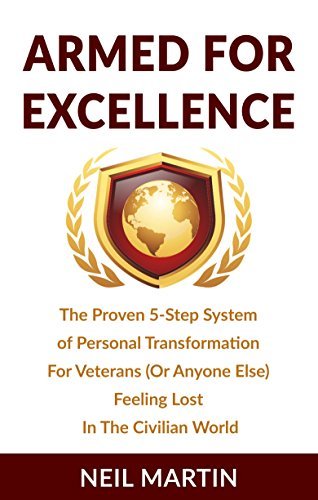
Author of Armed for Excellence.
Alongside the consultancy work, I am the author of Armed for Excellence, a Kindle bestseller — a proven five-step system of personal transformation for veterans, or anyone else, feeling lost in the civilian world.
Tell me what is going wrong.
A short conversation is usually enough to work out whether I can help, and what the first move should be.